Kids and Video Games

February 15th, 2005

What, can’t drag Johnny away from that book he’s reading? Can’t get Suzy inside the house on a beautiful spring day? Like most parents, you want your little kids to be playing video games, and you get worried when they seem disinterested, or they find the games too frustrating or confusing.

Well, I’ve got some tips for you:

First, ease them in with some educational games. If you have a Windows machine (even an older 200-300 Mhz machine will do nicely), I recommend the Reader Rabbit series, which has been great – right from the preschool version up to grade two. Kids seem to be able to figure out the mouse fairly easily – one of our kids had it down before she turned two, while the others all had it by the time they turned three. Plenty of different minigames and tasks are tied together with some sort of story that gives the kids something to work towards. It also works well for a group of kids – one kid uses the mouse, but the others are happy to give advice, and enjoy the story and music.

Now, time to get them playing some (almost) real video games. I used to hate that purple dinosaur, but when I discovered a Sega Genesis game about Barney for just a couple bucks at the thrift shop, I had to get it, and see if it was good for the kids. And sure enough, it’s like the Rosetta Stone of gaming for little ones. It’s a typical side-scrolling platform game, sort of like Super Mario Brothers or Sonic, but with a couple important changes. First of all – Barney can’t die. This might sound like a major disadvantage (Barney dying all sorts of horrible deaths could have been a really strong selling point for the adult crowd) but from the kid’s perspective, this is great. Little kids have enough trouble coping with the controls, never mind avoiding enemies and jumping over wide chasms. Secondly, if you don’t touch the controls for a while, Barney just starts walking by himself, and will finish the level on his own. So kids can just sort of sit there with the controller, feeling they’re doing something even when they aren’t. And as they start to clue in that pressing left or right on the pad makes Barney walk, or pressing the button makes him jump or hug (yes, hugging is a big part of this game), they slowly become video game players.

Once Barney has caused the great awakening, kids are ready for all sorts of other games. The next one I recommend is Bowling for the Atari 2600. This’ll get them going on a joystick, which surprisingly is a lot trickier for a kid to figure out than a gamepad or especially the mouse. All you have to do in bowling is press the fire button, and the ball (more like a square) will roll (okay, slide) down the lane and hit the pins (more squares). It’s all accompanied by simple, yet distinct and attractive sound effects. After a while they’ll figure out that pushing up and down on the joystick moves the man up and down, and so forth.

Once they’ve got these skills down, they’ll be ready for some newer systems. Mario World 64 on the Nintendo 64 is great, as there are large areas with no threats, where Mario can wander around as they get used to the controls. There’s plenty of exploring to be done in the castle when they feel comfortable.

Once the N64 control pad is mastered, no problem moving to some Vigilante 8 on the Dreamcast, Crash Bandicoot on the Playstation, or Mario Kart: Double Dash or Mario Sunshine on the Gamecube.

Pretty soon all your concerns about books and outdoor play will be over.
Electronic Music

February 7th, 2005

My tastes in music have changed a lot over the years. In the early 80s I was listening to the current top-40 type stuff, like Billy Joel or Bruce Springsteen or, dare I admit it, Michael Jackson. Then I remember during the breakdance craze starting to listen to some rap and some techno-type music. Then by the end of the 80s I got into some harder rock and metal, but also into those dance-remixes that were becoming very popular.

Grunge arrived in the early 90s, and I liked the “be real” or “who cares” messages. Plaid, bass, drums and guitar is pretty much all I wanted, though a certain form of folk music fit in with this view too, and that was cool. I pretty much despised electronic instruments, like keyboards and drum machines (with the notable exception of Richard Pepper’s music, of course).

However, throughout all this time I never stopped liking my favourite computer and video game music. From the moody (both happy and dismal) music of Super Mario Land on the original Gameboy to the Commodore 64’s SID chip – the medieval songs of Ultima III & IV, the super-long epic soundtracks of Delta and Tetris, and the many games that Rob Hubbard’s tunes made so much better (Last V8 and Master of Magic to just name a couple). Great stuff!

So what’s the difference? I think it has to do with how I perceive music as being honest, or real. Most 8-bit type music is blatantly computer generated. Nobody is trying to hide anything – it’s in your face. What I grew to dislike was electronic instruments trying too hard to be real. And it seemed the same artists that were happy to use a keyboard to replace their bassist and a little black box to replace their drummer were the same ones that wanted every last note in their recording to be sequenced to “perfection” – and they ended up sounding like yet another over-produced, homogenized piece of, um, music.

A lot of the music I’m listening to now is from individuals or small groups that are using 8-bit sounds in their music. Tree Wave uses a C64, Atari 2600, luggable ancient PC clone and a dot matrix printer(!) to make some fantastic music. Bud Melvin does a live show with Gameboy, banjo, and vocals. His recording of “Moonglow” is one of my favourite songs, ever.

These bands aren’t using electronic music to sound slick, or over-produced – they’re just using it to create cool sounds and original music. They’ve got the honesty in their art that makes me want to listen, even if it just sounds like beeps and boops to other people.

Tron 2.0 Killer App

February 4th, 2005

Not only a really good pun, Tron 2.0 Killer App for the Gameboy Advance is also an excellent game. I spent this last weekend playing Tron whenever I could. It’s a fairly short game – I was able to finish it in two days, but it was a good trip, and it’s full of extras that will keep me coming back for quite a while.

The main game is an isometric platform/shooter game. You guide your choice of Tron or Mercury through several levels. Each program (that’s what the “people” in Tron are called) has their own mission and areas to explore – occasionally their stories intersect, but essentially you have two seperate adventures in the same game universe. These levels generally involve exploration to find keys to pass through to different areas. Sometimes you encounter other programs that give you help, or want to make a trade with you. Upgrade chips are found which enhance your abilities, or unlock other parts of the included mini-games.

From time to time the game shifts to a remake of the classic overhead light-cycles game, and also to two different 3d games – one where you drive a Tank around, and the other where you fly a Recognizer around. At first I didn’t like the 3D parts much, but I really got into them after a while. Flying the Recognizer is excellent once you’ve mastered the controls.

The mini-games are super-great. There are three puzzle/action games that you need to master as Tron and/or Mercury go through their adventure. One is a puzzle game, sort of like Pipemania except the pieces are hex shapes – this game is used to hack terminals scattered throughout the game areas. Another game involves defragmenting a program – if you’re attracted to watching the Windows disk-defragmenter work (I am, strange as it may be) you’ll probably love this game. Finally, the last game involves shooting through a firewall to get at this crazy program that looks like a disco-dancing robotic crab. I think this is the weakest of the games, but it’s reasonably fun, kind of a bit like Yar’s Revenge or the last level of Phoenix, but with power-ups and a couple extra complexities.

All 3 of these games are available to be played directly from the mini-game menu, in addition to their appearance in the main game. Also included in the mini-game menu are both of the original Tron arcade games from 1982 and 1983, which are recreated perfectly, at least, as far as I can tell. The Tron game from 1982 is a long-time favourite of mine – a very difficult but addictive game involving 4 different sub-games. Each time you complete all 4 parts, you repeat with the difficulty ramped up substantially. Very cool getting portable versions of these great games.

Anyway, that’s a whole lot of value packed into one game. And all that playing makes me want to watch my Tron DVD again!

Wrong address/phone information will cause Parcel Lose.

February 2nd, 2005

I’ve written before about how much I enjoy good ol’ NHL 98 on the Sega Genesis. My friend Victor organizes approximately three tournaments a year where we get together and play this game. Two of the three involve modern NHL rosters. This becomes more of a problem which each passing year, as more and more of the players retire, or get traded, and new players enter the league, and the NHL 98 rosters become increasingly inaccurate. A few custom players can be entered in the battery-backed-up cartridge, and players can be moved around from team to team. This is quite a procedure – Victor makes a many-paged recipe list of what needs to be done, step by step, and then he (sometimes with my assistance) goes through this one, maybe two hour procedure for each cartridge. In bigger tournaments, this needs to be done 3 times! And then there’s the risk of the cartridge getting accidentally reset.

I’ve long dreamed of being able to directly modify the NHL 98 cartridge with new rosters. Some years ago I discovered more-or-less how the players and teams were encoded in the cartridge with a hex editor program (incidentally, I actually used a hex editor at work today, legitimately!) but didn’t know how to take it to the next step of actually using the edited binary file on a real Sega.

I’ve always been fascinated with anything programmable – starting with the PET, Timex-Sinclair 1000 and C64s of my youth, and then into calculators and game consoles. Game consoles in particular are usually closed systems – no keyboard or disks or operating system to allow you to enter your own programs, besides pre-packaged cartridges, or more recently, CDs. Enterprising individuals (mostly located in Hong Kong) have created “flash carts” – cartridges containing flash memory which can be changed. Hook one of these devices up to a recent PC through the parallel or USB port, and the cartridge is flashed with whatever binary image you choose. These devices have become extremely popular on the various Gameboy incarnations, and are used 99% of the time to play pirated games. Of course, they’re sold as “game development kits” 🙂

So, while searching online for a flash cart for my Gameboy Advance (for game development, of course!) I found a flash cart for the Sega Genesis! This is exactly what I need to go further with Project Genesis: NHL 2005 (or 2006). If all goes well, I hope to write a program that would allow Victor to change player names and stats easily in a text editor, then interpret those changes and put it in the binary file, which is then burned on the cart.

So, I ordered one of these flash carts today – maybe Victor will buy one too, if my experiments go well. The title above was the message I received when my order was completed. Yes, I trust these people with my money 🙂

Robin’s Green Bass vs. Richard’s Yamaha Acoustic Guitar

January 26th, 2005

Richard and I have had a running joke that playing the bass is just a subset of playing guitar, and therefore, any decent guitarist is automatically a decent bassist. Well, it’s usually Richard’s joke, and I’m the butt of it.

It got brought up again in Richard’s blog, and so I’ve been thinking about this again, and an associated question, is the bass itself just a subset of the guitar?

Well, let’s compare my 5-string bass with Richard’s well-used 6 string acoustic guitar. You might be surprised to learn that his guitar is actually less capable than my bass! As in, it’s multi-tonally challenged. Like, it doesn’t represent as broad a frequency spectrum as my bass. Proof? Read on.

I’ve got a full two-octave neck, which means I have 25 notes available per string, for a total of 125 non-unique notes. Richard’s guitar neck meets the body at the 14th fret. Maybe you can usefully play another 3 notes or so past there – let’s say 5 for the sake of argument. So let’s say 20 notes per string, for a total of 120 non-unique notes. Bass in the lead!

What about unique notes? Well, I’ve done some figuring, and it seems I have 45 unique notes available, thanks to the 5th string and the 24 frets, from the lowest B up to the high G, almost 4 octaves up. Richard’s guitar? Well, if he can usefully use up to the 19th fret (and listen, like I have – he can’t) he’s got a total of 44 unique notes available, from the low E to the high B, not-so-almost 4 octaves up.

My bass has 17 unique notes that I can play that Richard can’t get on his Yamaha. These are some pretty sweet, fat, resonate notes too, by the way, starting at the 1st fret on the second highest string (D#) all the way down to low B. The acoustic? 16 plinky notes, starting with G# on the 4th fret of the highest sounding string, and working up as far as Rich’s fingers can stretch.

So there you go, Green Bass wins on every count. I trust this will put Richard’s bass comments to an end, except perhaps the now obviously self-deprecating ones he’ll be obliged to make.

Hey, that’s two in a row for the “and other thoughts” category.

My Lame Cartoon Idea

January 21st, 2005

Just because Rich and Shroom have been sharing their kinda joke / cartoon ideas:

While walking back to my truck in the Canada Games Complex parking lot, I was about to walk by a fairly distinguished looking fellow, probably in his 50s, who was heading towards the building. For the last several years I’ve deliberately tried to make eye contact with strangers I pass by, and at least give a friendly smile or nod or “hello” if given the chance. Well, he went right on by without giving me any notice, and then I was surprised to hear him start talking, presumably to himself. I turned around to look, in case there was someone else in the area I didn’t notice, but nope, no one. Then I caught myself almost talking to myself about it 🙂

So, the cartoon of this event would be one of those 3 frame things – first would be the picture of the two guys approaching each other, making it clear no one was around. The second would be of them having passed each other, and the stranger mumbling something to himself that obviously had nothing to do with their “encounter” (boy, even that word has become corrupt!). And the third would be the character we’re familiar with, saying (obviously to himself, not the audience) – “Weird, that guy talks to himself!”.

Feel free to rate it compared to other cartoons. “That’s about as funny as Marmaduke” or “I’d rather just read the same Garfield strip over and over again every day for the rest of my life than read anything else by you.”

Not a DTV bug!

January 7th, 2005

I’ve heard a bit of complaining about the C64 DTV and bugs it has. Few of them are legitimate – most are unfortunate manufacturing defects that affect some units.

There’s the sound problem that one of my four sticks has – go into Hot Dog in Winter Games and if it sounds like the crashing sea, or if you play a game of Uridium and get very annoyed by a piercing noise instead of the really difficult attack waves coming at you too fast, you’ve got it too.

There is a software bug too, caused by *me* – but it’s so obscure (and doesn’t affect gameplay at all) that I think no one has found it yet. To narrow it down, it’s in a game starting with E. Comment when you’ve discovered it!

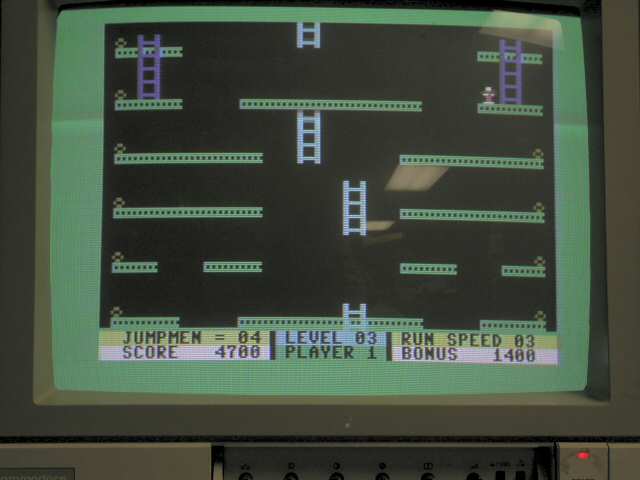
But level 3 of Jumpman Jr. doesn’t have a bug. I’ve heard this a few times: the ladders get seperated, and get stuck to the top or bottom of the screen. Well, the original does that too – I just played a game on my 21 year old Jumpman Jr. cart I bought for $10 at Zellers. My buddy Ron and I hoped on our bikes, and without getting permission from our parents, went and blew some of our paper route earnings. Ron bought Gateway to Apshai, also on cartridge, on that trip. And because of the intense nostalgia associated with both of those games, I did everything I could to get them both on the DTV, and it worked 🙂

Anyway, look here for the bug on a real C128, 1902A monitor, and Jumpman Jr. cart.

Don’t Bogart the Stuffinged Lamb

January 6th, 2005

Way way back in 1997, just a little before I became a father, I got a hand-made envelope in the mail, containing a brief letter, and a 5.25″ floppy disk. It was from a ~14 year old Dustin Chambers. He had seen one of the Commodore 64 demos Darren and I had done, it had included my mailing address, so he wrote. The disk included a bit of art and code and stuff he was working on. Pretty neat! He wondered if he could join the group, and I said sure thing. We did one demo together (called 12th Day, released on the 12th day of Christmas, which was exactly 7 years ago yesterday, I think) and have stayed in touch ever since. I’ve helped him with a few other projects since then too.

We’re hoping to have a new demo done in the near future – DTV work has kept me from some of these other things I want to work on (but I’m not complaining!). Dustin’s part is looking quite good.

And I finally met Dustin Chambers (aka Fuzz) in person while at the World of Commodore in Toronto in early December. He drove down from the Ottawa area where he’s going to university. Things were kind of hectic at the show, so I’m disappointed that I didn’t get to spend more time with him. At least we were able to sit together, discussing division routines in assembly language, over the best, but most expensive buffet meal I’ve ever had. Mmmmm, battered white fish and lamb stew….

I’ve Had Some Sleep

January 4th, 2005

I was waiting for someone to leave comments like that, Richard and Erinose. Eventually, I would have left a similar comment myself!

I’ve been spending most of my free time working on the PAL (European TV standard) version of the C64 30-games-in-one joystick. The rest of the time I’ve been thinking about what I should be doing on it. Not ideal blogging conditions, unfortunately. Things are slowing down on that now, so I can make a post somewhat guilt-free.

I think I was supposed to say a bit more about my trip to the World of Commodore in Toronto in early December. The biggest thrill was meeting Karl Hildon, former editor of the greatest magazine of all time, The Transactor. I’ve still got several issues I bought down at “Little Richard’s” corner store back in 1986 or so.

Transactor was a magazine about Commodore computers, but unlike any other. It was totally into the technical side of things – advanced programming, hardware hacking, all that sort of stuff. Almost all of it went over my head (especially when I was 13 years old), but every time I read from them, I’d learn a little more.

I don’t know what Karl thought of me at first – perhaps he had never run into a rabid fanboy before. But after a while he seemed happy to share lots of memories of his time running the magazine, both good and bad, and even several adventures after he left. I even learned some of the story behind the really cool and unique cover art the magazine had, and even more obscure trivia. Cool cool cool.

Karl gave me a copy of his book “The Complete Commodore Inner Space Anthology”, and signed it for me. And in a weird twist, he received one of the Commodore joysticks I had worked on. He came back the next day with his electric engraver, and had Jeri and me buzz our signatures into the side of it 🙂 Trading autographs with your childhood hero, how cool is that?!

Back from World of Commodore 2004

December 6th, 2004

Got back tonight, and my friend Adrian is happy to host the pics I took at the World of Commodore in Toronto this weekend. You can see all the pictures here. Any picture with a * beneath it has a comment – I made a bunch, other people will probably add theirs too. More reporting after I’ve had some sleep.