The Harbron’s First Law of Blogging

March 15th, 2006

Carla and I think we’ve discovered a fundamental truth of blogging:

The number of comments you receive about a post is inversely proportional to the amount of effort you put into writing that post.

You want anecdotal evidence? Look no further than this very page. My last three posts all took just 5-10 minutes to put together – quick posts about spotting chocolate mistakes and goofy microwaves and Mountain Dew, and all received significant attention. Then the next post (about Lego) I do significant research into, probably spending nearly an hour on it, and I get the big egg as far as comments go.

It’s not just recently either – I once wrote an epic comparison of the games Autoduel and Car Battler Joe that surely took me two, maybe even three hours to write. Carla’s written long, well thought-out essays on education and motherhood. Comments? Zilch. But post a link to some goofy video, or one of those online quizes – takes 30 seconds, and it’s a jackpot as far as the comments go.

This isn’t a complaint – I don’t blog for comments, though I surely appreciate them – I blog because I want to write about things, because I want to add my knowledge and thoughts (whatever they’re worth) to the collective – and I like to write to get things out of my mind and potentially into someone else’s.
Coding Fuel

March 13th, 2006

I’ve been staying up late some nights lately, coding for pay on a really cool project. More about that sometime.

Of course, late night programming requires fuel. Two quick stories about that:

For food I always choose microwave heated left-overs, if available. Our microwave (a wedding gift, so circa 1996) has a cute feature: when it’s done zapping stuff, it scrolls “ENJOY YOUR MEAL” across the display. That’s fine when I’ve got a plate of rice pilaf and meatloaf like tonight, but it’s a little gross when I’ve just finished thawing a big stack of burgers for a family BBQ. Or even worse, melting a big wad of butter in it. Mmmm, enjoy your meal of butter.

Drink-wise, Mountain Dew is the thing for late night coding. Not our wimpy Canadian ‘Dew either – it’s gotta be the caffeinated American stuff, or recently, the caffeinated Mountain Dew Energy that can be bought at dumb Superstore (and probably elsewhere, not that I go anywhere else). I was feeling daring tonight, so I mixed a Diet Mountain Dew Energy with an American can of (sugared) Mountain Dew. Nothing exploded, and it tastes pretty good.

Chocolate Bass – Spot The Mistake #2

March 11th, 2006

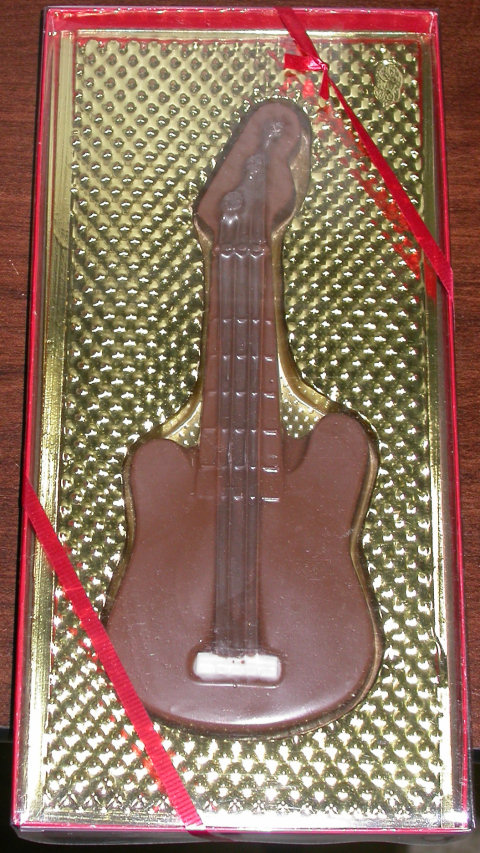
A chocolate bass guitar
Here’s the other chocolate thing. I’m not even sure it was supposed to be a bass guitar, but it does have 4 strings, so let’s assume that’s on purpose. I wonder if there’s a term for the maximum “chocolate-resolution” they can get out of the medium and the molds? Maybe that’s why they went for 4 strings rather than 6.

Anyway, what’s the goof this time?

Chocolate Computer – Spot the Mistake

March 9th, 2006

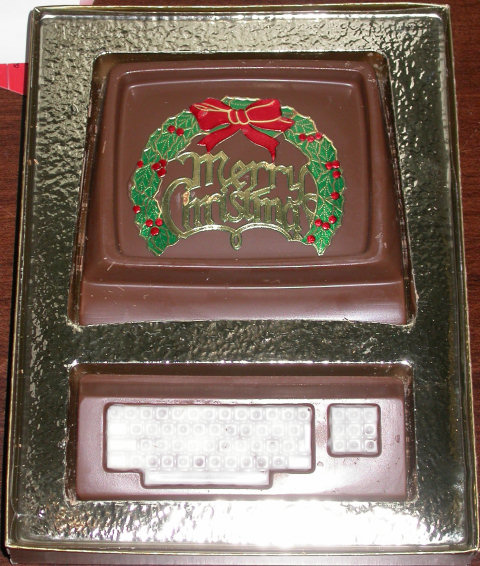
A chocolate computer
I got a few special chocolate things for Christmas (yes, it’s taken a while for me to get around to posting about it) from my kids that made me laugh. They’re all things that the kids relate with me. Being the eagle-eyed nitpicker that I am, I noticed problems with two of them that I found amusing, so pictures were taken before the chocolate was consumed.

Here’s the first one, a chocolate computer. Sorry about the camera flash making it a bit more difficult, but can anyone see the problem with it? Besides “of course your computer won’t work, it’s made of chocolate!”

Non-Spam from Strangers

March 7th, 2006

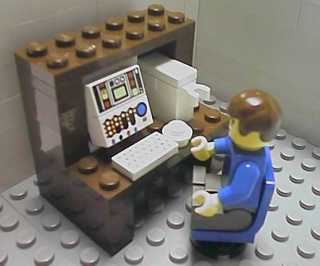
Robin at his computer deskBack when this big ol’ Interweb was still a pretty new thing (say, 10 years ago) spam was pretty much non-existent, even when you were dumb enough (as I am) to post your email address plain as day on your web pages.

Back then I would frequently get email from people who hit one of my computer pages, and were looking for more info, or who just wanted to say “your page and/or the stuff on it is cool”. Basically, email from strangers was almost always cool. Nowadays, almost all email from strangers is not cool.

Today was a good email day though… so here we go, from the mail bag:

    Hello,

    I just wondered.. Where did you get that cool computer lego?

    on this page: http://my.tbaytel.net/macbeth/computer.html

    Thanks

    Adrian

Hi Adrian, thanks for writing. Peeron.com is a fantastic resource for the OCD Lego fan – an amazing database of just about every Lego piece ever made, cross-referenced with just about every Lego set ever made. Without it, I’d hardly be able to answer your question beyond “I bought the Lego at the store.”

Instead, I can be painfully accurate – the three printed tiles (that’s what we call the flat Lego elements with no studs on top) I used on my Lego computer can be found on Peeron.com here:

Tile 1 x 2 with Controls Pattern, ‘Tile 1 x 2 with Keyboard Pattern’ and ‘Tile 1 x 2 with Red and Yellow Controls Pattern’.

Each page has a list of sets that the part was in – so my best guesses for where I got those parts are: Set # 1351-1: Movie Backdrop Studio and Set # 6453-1: Com-Link Cruiser. They even have links to places still selling those sets, or individual pieces if you want.

Book’d

March 4th, 2006

Pile of Programming Books

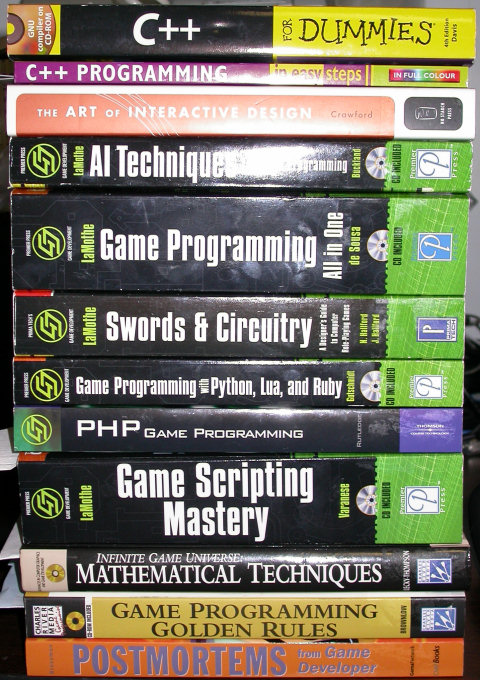
Wandering through Superstore, I saw one of those big 4′ square bargain bins full of books. Quite surprisingly, it was full of computer books – not just Windows for Dummies, either, but programming books, and plenty about game programming!

Because I can’t program, I’ve been doing what I can to rectify the problem, so I dug into the bargain bin, creating precariously high piles while I sorted through, trying to figure out all the titles they had, and which ones interested me. Why are bargain bins always laid out so you pretty much have to touch and look at every last item to know you’re not missing anything you might want?

Anyway, I ended up with the pile of books seen here – well, the first two I bought seperately – one at Value Village for $4 and the other brand new at Chapters for only $15 – very cheap for a new computer book. The Superstore books ranged from $7-$15 each, while the list prices ranged from about $45-$92. Some of the books were as recently printed as 2004.

I ended up getting “carry out” help to my truck – I didn’t come in with a cart since I didn’t know I’d find these books, and they wouldn’t let me take one of the baskets out of the store, and I wasn’t about to buy bags to carry 30 pounds of books, which probably would have ripped anyway, and I couldn’t carry my planned purchases along with the extra books without the basket. Dumb Superstore, I sure showed them.

I’ve been enjoying my pile of new books – great bedtime reading.

Final Novel Excerpt

February 28th, 2006

It seems I never got posting the final bit from my unfinished alternate history of video games novel, so here it is:

Another contender for the title of “first computer game” is Professor Bruce MacKenzie’s pioneering “5-Pin Bowling Season Simulator” game, also written in 1946, at the University of Toronto, Canada. Prof. MacKenzie had both a PhD in Applied Mathematics, and a keen interest in 5-pin bowling, particularly betting on results.

He strived for as much accuracy as possible within the constraints of those early computer systems, attempting to model each player as best he could, hoping to improve his odds of winning his bets on the big games.

At first he kept his program a secret, but after two seasons of excellent returns on his bets, people became suspicious of his success. One particularly keen student of his, after losing quite a bit of money to the professor, managed to discover the program on the mainframe, altered it slightly, and in revenge, sent the game to every other university computing centre that had compatible hardware.

The controversy surrounding the game made it the talk of many campuses, and many people tried it out and became addicted, even in foreign countries where they had not heard of 5-Pin bowling before. Before long people were wanting to try this exhilarating sport out in person, and enterprising businessmen from Canada began opening bowling centres all around the world. This directly led to the phenomenon that 5-pin bowling is today, growing from a quaint Canadian sport to fueling huge multi-million dollar 5-pin bowling complexes in China, Japan and Germany, as well as the popular “5-Pin Bowling Action” sport video game franchise that sees annual releases with current rosters, and improved pin and bowler physics, and increasing use of the latest 3d graphics hardware.

It’s even left a mark on the Interweb, where players participate in 5-Pin Bowling fantasy leagues, trading virtual representations of star 5-pin bowlers, hoping to form a true “Dream Team” and win the championship after a long season of strategizing and fantasizing.

Old TV

February 22nd, 2006

I’ve blogged about it before, but Darren’s post today got me doing a bit more googling for some old favourite shows. I inaccurately commented on his blog that “…I’ve done some searching online for both Jeremy and Secret Railroad, which along with Dr. Snuggles are my favourite kid’s shows that I can’t watch. The other ones are still on TV in some form, or easily available on DVD.”

Well, then I found this page: http://www.rickstv.com/tvo/skedaug84.html – and was reminded of many more shows I watched as a kid. I guess some days I’d watch every show aired on TVO! (Incidentally, weird that the times for TVOntario are listed in Newfoundland time).

So here’s a greatly expanded list of shows I remember fondly, and would certainly be willing to pay to watch some of these again, and show them to my kids (realizing that some of them are probably awful now):

Polka Dot Door (but only a little bit!)
Barbapapa
Simon in the Land of Chalk Drawings
Readalong
Cucumber
Hattytown Tales
Vision On
Willo the Wisp

Update: here’s a link to the main TVO page on Rick’s TV.

Finally, did I mention that I got Season One of Fraggle Rock for Christmas? That’s a show that has aged extremely well – I’ve been watching the whole season with my two oldest daughters, and we’re enjoying it very much.

Commodore Round-Up

February 16th, 2006

C64hq has had a lot of cool exclusive material over the last few years. The most recent addition is the “Commodore C64C Introductory Audio Tape” made in 1990. As they mention on the website, it’s “very British”. If you like the C-64 and the narration from The Hitchhiker’s Guide to the Galaxy, you’ll probably like this.

Other cool stuff in C64hq’s Audio/Video section include some C64 music concert video footage, original Rob Hubbard sythesizer recordings from before he turned the songs into SID tunes, and some Visa Röster recordings, such as their excellent cover of the title track from Thrust.

I ordered JiffyDOS for my VIC-20 today. It was just released, and I’m really looking forward to playing with it. The main advantages it offers are much faster disk access, and handy keyboard short-cuts, with a built-in DOS command wedge. You can order it here: cmdrkey.com

Finally, I’ve got a programming class planned for March. I’ll be teaching probably six kids how to program, and of course, we’ll be using C-64s. I’m really looking forward to it, and we’ll see if it leads to me developing further computer curriculum. I think there’s a real lack of good computer education nowadays. I wonder where our future programmers are going to come from, if they’re not being exposed to programming before they choose it in post-secondary education?

C64CGC 2006

February 12th, 2006

The 2006 C-64 Crap Game Compo has been launched, and three games have already been entered. The goal this year is to get 50 games entered so they can be put together in a compilation called Cassette 50 Reloaded which will be sold through Cronosoft, the 8-bit games publisher that’s too cheap to even pay a couple bucks for webhosting. All proceeds from Cassette 50 Reloaded (which will be sold on disk) will go to a charity chosen by this year’s organizer.

The compo had gone astray in the last couple years. Many of the entries weren’t even games, and instead they were joke entries, and very deliberately poor. The last thing we need, in my opinion, is really deliberately bad games.

This year marks the return of the original spirit of the competition, which I think is similar to the NaNoWriMo writing competition: actually sit down and work on something that you’ve been wanting to for a long time, have some fun doing it, ignore your inner voice that tells you you’re going to be a failure (even if it’s perfectly right!) and get something done. Yes, it’ll very likely be crappy, whether it’s a novel or a game, but there will probably be something good in there too. And at the end of it, you’ll have something to show for yourself, and possibly further improve later.